Indian Delegation Explores Ghana Free Zones Investment Opportunities
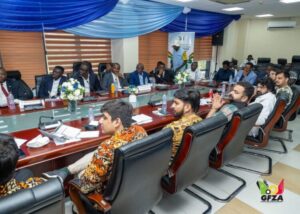
Ghana is seeking to deepen its economic and commercial relationship with India as a 16-member Indian business delegation explores investment opportunities under the country’s Free Zones Scheme, with particular interest in manufacturing, renewable energy, agro-processing and emerging technologies.
The Ghana Free Zones Authority (GFZA) hosted as part of efforts to attract foreign direct investment, expand industrial production and strengthen Ghana’s position as a preferred investment destination for international businesses.
Dr. Mary Awusi, Chief Executive Officer of the GFZA, welcomed the delegation and highlighted Ghana’s political and economic stability, strategic geographical position and access to the wider African market through the African Continental Free Trade Area (AfCFTA).
“Ghana offers investors a stable business environment, strategic access to the African market and opportunities to establish competitive businesses through the Free Zones Scheme.”
The delegation comprised representatives from 11 Indian companies operating across several industries, including renewable energy, agro-processing, healthcare, artificial intelligence, infrastructure, drone technology and manufacturing.
Their engagement with the Authority provided an opportunity to examine Ghana’s investment environment, available incentives and prospects for establishing or expanding business operations in the country.
Free Zones Scheme Offers Investment Incentives
The engagement focused on communicating the investment opportunities available under Ghana’s Free Zones Scheme, which is designed to encourage export-oriented production, attract foreign capital, facilitate technology transfer and support industrial development.
The scheme provides participating businesses with an investment framework that supports manufacturing, processing and other eligible commercial activities while positioning Ghana as a potential production and export hub for regional and international markets.
Dr. Awusi particularly drew attention to the Single Factory Free Zones arrangement, which offers businesses flexibility in determining where to establish their operations.
Under this arrangement, eligible companies can operate from locations of their choice anywhere in Ghana while enjoying the incentives and benefits associated with the Free Zones Scheme.
The flexibility is particularly relevant to businesses operating in sectors such as agro-processing, manufacturing and renewable energy, where proximity to raw materials, production infrastructure, suppliers and distribution networks can influence investment decisions.
It also creates opportunities for investors to establish facilities outside traditional industrial enclaves, potentially extending the benefits of industrial investment to different regions of the country.
For Indian businesses considering entry into Ghana, the arrangement could provide an opportunity to structure operations around their specific production requirements while taking advantage of the country’s investment framework
“The Single Factory Free Zones arrangement allows eligible businesses to operate from locations of their choice across Ghana without losing access to the incentives available under the Scheme.”
Indian Companies Eye Ghanaian Market
The participation of companies from 11 different business sectors reflects the diversity of investment interests represented by the Indian delegation.
Renewable energy, artificial intelligence, drone technology and infrastructure are among the sectors increasingly associated with technological development and industrial transformation.
Meanwhile, agro-processing and manufacturing remain important areas for Ghana’s economic development, particularly as the country seeks to increase domestic value addition, expand industrial capacity and strengthen its export base.
Investment in agro-processing, for instance, could support the development of local agricultural value chains by creating opportunities for processing, packaging and exporting agricultural commodities rather than relying predominantly on the export of raw materials.
The delegation’s leader, Nikhil Jayendrabhai Methiya, expressed appreciation to the GFZA for hosting the group and providing an opportunity to understand Ghana’s investment environment.
“The engagement has provided our delegation with a deeper understanding of Ghana’s Free Zones Scheme and the investment opportunities available to Indian businesses.”
Existing Indian Investment Strengthens Relations
The growing participation of Indian-owned businesses in Ghana’s Free Zones Scheme provides an existing foundation for expanding commercial relations between the two countries.
Dr. Mary Awusi Presenting a Made-In-Ghana Product to the Indian Delegation
According to the GFZA, 22 Indian companies currently operate under the scheme, with 14 of them wholly Indian owned.
The figures highlight the established presence of Indian businesses within Ghana’s export oriented industrial sector and demonstrate the potential for attracting additional investors from the Asian country.
The presence of these companies could also provide prospective investors with an opportunity to understand the operating environment through the experiences of businesses already participating in the scheme.
For Ghana, attracting additional Indian investment could support industrial expansion, create employment opportunities, facilitate skills development and introduce new technologies into the local economy.
The engagement also aligns with the country’s broader efforts to attract strategic foreign investment into productive sectors, strengthen international trade partnerships and position domestic industries to benefit from opportunities under AfCFTA.
“Strengthening investment relations with India will create opportunities for greater business cooperation, industrial development and expanded trade between the two countries.”
The development of stronger Ghana–India commercial relations could contribute to expanding investment flows, diversifying industrial activities and strengthening Ghana’s capacity to serve as a production and export destination for businesses targeting the African market.