



The Chief Executive Officer of the Ghana Chamber of Mines, Ing. Kenneth Ashigbey, has staked the long-term future of Ghana’s extractive sector on structured dialogue, institutional partnership, and ethical accountability rather than output volumes alone.
Addressing stakeholders at the 12th Ghana Mining Industry Awards in Accra, Ing. Ashigbey emphasized that meaningful collaboration among mining firms, regulators, and host communities is indispensable to turning mineral wealth into enduring national progress.
“While we may not always agree on every issue, our engagements are guided by a shared commitment to sustainable development of Ghana’s mineral resources.”
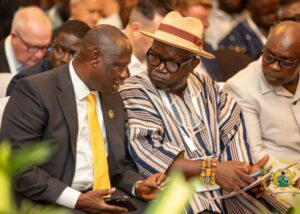 In advancing this posture, the Chamber’s leader positioned mutual respect and transparent engagement as the practical foundation required to resolve regulatory friction, curb environmental degradation, and align commercial extraction with public welfare.
His intervention comes at a decisive juncture for the industry which injected over GH¢22.22 billion into the national economy in 2025 as policymakers review the Minerals and Mining Act, debate major lease renewals, and confront intense public scrutiny over illegal mining and ecological restoration.
Redefining Industry Success Beyond Output Metrics
For decades, public evaluation of Ghana’s mineral economy has centered largely on bullion output, export receipts, and fiscal inflows.
Ing. Ashigbey challenged operators and policymakers to retire that narrow scorecard in favor of broader social and ecological benchmarks.
He maintained that the sector’s durability hinges on pairing commercial viability with strict workplace safety, technological innovation, and tangible improvements in host communities.
“For me, the answer must include an industry recognised not only for its production and economic contribution but equally for its integrity, innovation, environmental stewardship, commitment to safety, and positive impact on our communities,” Ing. Ashigbey stated.
That call reflects growing recognition within the extractive space that a legal license to mine no longer guarantees operational stability without a corresponding social license from affected citizens.
Across gold-producing districts, communities increasingly demand verifiable local procurement, reliable infrastructure, and transparent reclamation guarantees before endorsing long-term extraction.
By elevating environmental guardianship and worker protection to the same tier as financial returns, the Chamber seeks to insulate compliant large-scale operators from reputational damage caused by illicit mining activities.
Institutional Cooperation Amid Regulatory Transition
Sustaining high operational standards requires cohesive oversight across state agencies, yet friction between operators and regulators has periodically slowed policy execution.
Ing. Ashigbey commended the working synergy between the Chamber and key state institutions, specifically citing the Ministry of Lands and Natural Resources, the Ministry of Environment, Science, Technology and Innovation, the Minerals Commission, the Environmental Protection Authority (EPA), and Parliament.
He argued that candid, respectful consultation remains the most reliable mechanism for reconciling differing viewpoints without derailing sector growth.
Rather than allowing policy disagreements such as fiscal adjustments, local content thresholds, or environmental permitting timelines to harden into adversarial standoffs, stakeholders must anchor negotiations in shared national goals.
Industry analysts note that this collaborative approach is especially urgent as Ghana navigates ongoing statutory reforms and heightened fiscal expectations from extractive revenues.
When regulators and producers maintain open channels of communication, compliance improves, investment predictability strengthens, and enforcement against unregulated operators becomes far more coordinated.
Anchoring the Forthcoming Centenary in Legacy
Looking ahead to the Ghana Chamber of Mines’ centenary milestone in 2028, Ing. Ashigbey urged industry actors to treat the anniversary as a strategic checkpoint rather than a nostalgic festivity.
Having operated as an organized body since 1928, the Chamber enters its second century amid rising global standards for responsible sourcing and environmental, social, and governance compliance.
“Our centenary will therefore be more than a celebration, it will be an opportunity to excellency and define the legacy we wish to leave to the next generation,” Ing. Ashigbey remarked.
To translate that vision into measurable outcomes, he called on mining executives, traditional leaders, and public officials to use the pre-centenary window to tighten operational benchmarks and deepen community empowerment.
Ing. Ashigbey underscored that the true measure of a century of organized mining in Ghana will lie in the health of restored ecosystems, the safety records of underground and surface operations, and the economic resilience of mining towns long after mineral deposits are exhausted.

