



Dr Zanetor Agyeman-Rawlings Ghana’s
Minister for Environment, Science and Technology, has warned that the destruction of Ghana’s water resources through illegal mining and other forms of pollution poses a growing threat to national security, public health, food security and economic stability.
Speaking at the launch of the National Water Restoration and Rehabilitation Framework in Ho, the Minister argued that access to clean water must be treated as a fundamental component of human security, warning that environmental degradation carries consequences extending beyond the immediate destruction of rivers and ecosystems.
She further cautioned that prolonged exposure to heavy metals and other contaminants could produce serious health complications, while the destruction of natural resources threatens livelihoods, agricultural production and the country’s economic resilience.
“When we compromise our water resources, we compromise our food security, public health, economic stability, and ultimately our national security.”
Water Pollution Extends Beyond Environmental Destruction
Dr Zanetor called for a broader understanding of national security, arguing that environmental degradation must be recognised as a threat to the wellbeing and survival of communities.
She explained that rivers have historically sustained communities through agriculture, fisheries, domestic water consumption and industrial activities but are increasingly being compromised by illegal mining, excessive siltation and indiscriminate waste disposal.
The Minister expressed concern that Ghanaians were gradually becoming accustomed to the deteriorating condition of their rivers, warning that familiarity with environmental destruction must not translate into acceptance.
She maintained that the consequences of water contamination are not always immediately visible, particularly where communities experience prolonged exposure to heavy metals and other pollutants.
“As a medical doctor, I am particularly concerned about the cumulative effects of prolonged exposure to these environmental pollutants. The absence of immediate symptoms does not mean that no harm has been done.”
She further indicated that some consequences of exposure to contaminants might only become apparent years later, with implications for both current and future generations. The Minister also referenced increases in mortality, infant mortality, stillbirths and deformities among children born in areas where water has been contaminated.
Her concerns highlighted the need to approach water pollution not merely as an environmental management problem but also as a public health issue requiring sustained institutional attention.
Environmental Degradation Threatens Livelihoods and Economic Stability
Beyond the health implications, Dr Zanetor questioned the economic benefits of activities that generate revenue while simultaneously destroying natural resources and creating additional costs for society.
She argued that the proceeds from environmentally destructive activities could eventually be consumed by expenditure on disease treatment, water treatment, environmental rehabilitation and the restoration of livelihoods.
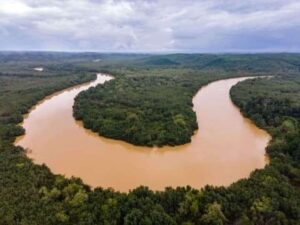
Water Bodies contaminated by illegal mining activities
The Minister also highlighted the difficulties confronting farming and fishing communities when pollution compromises the natural resources on which their economic activities depend.
She explained that farmers could lose the ability to cultivate their land, while fishing communities could experience the loss of livelihoods as water resources deteriorate. Such conditions, she warned, could intensify competition over increasingly scarce natural resources, creating tension and displacement.
“And if Ghana should lose revenue as a result of our agri produce being flagged as contaminated, environmental degradation becomes a national security issue.”
She also identified climate change as an additional pressure on the country’s water resources, noting that rising temperatures and changing rainfall patterns were increasing the challenges facing already vulnerable ecosystems.
The Minister maintained that Ghana could not afford to destroy the natural systems that provide resilience against environmental and climatic pressures. She stressed that natural resources are finite and warned that no amount of mineral wealth could compensate for the loss of the basic necessities required for human existence.
Zanetor Calls for Stronger Action Against Illegal Mining

The Minister identified preventing further environmental destruction as the first principle of any successful restoration programme. She cautioned against committing scarce public resources to rehabilitating rivers downstream while allowing pollution and destructive activities to continue upstream.
Dr Zanetor therefore directed the EPA to work with the Water Resources Commission, relevant ministries, security agencies, MMDAs and traditional authorities to map water bodies and protect designated riparian buffer zones.
She also warned against the misuse of activities described as dredging, reclamation or restoration to facilitate unauthorised mining and further pollution. The Minister insisted that environmental interventions must comply with existing regulations and undergo proper technical supervision.
She further called for scientific assessments to establish the nature and extent of contamination before restoration activities are undertaken. According to her, water-quality testing, sediment analysis, remote sensing and satellite imagery should inform decisions on the appropriate interventions for affected water bodies.
Dr Zanetor also emphasised that removing accumulated sediment through dredging does not necessarily eliminate dissolved contaminants or make water suitable for its intended use.
Minister Urges Public To Stop Protecting Environmental Offenders
In one of the strongest portions of her address, Dr Zanetor urged Ghanaians to stop interfering with efforts to apprehend individuals involved in illegal mining and the destruction of water bodies.
“When those who are engaged in this criminal activity of poisoning our water bodies and our land are apprehended, are arrested, please don’t go and beg for them. They are killing you. They’re killing us.”
The Minister further criticised the practice of intervening on behalf of individuals arrested for environmental crimes, regardless of whether such interventions come from traditional leaders, religious leaders, elders or politicians. She described the activities as criminal and called for the appropriate response from the relevant authorities.
Dr Zanetor specifically urged MMDAs to take a firmer position against environmental destruction, reminding them of their responsibility to protect communities. She explained that local assemblies serve as extensions of central government and have obligations to ensure that government policies are implemented effectively.
Government Introduces Coordinated Restoration
The Minister’s concerns informed the launch of the National Water Restoration and Rehabilitation Framework, which seeks to establish a coordinated and science-driven approach to restoring Ghana’s water resources.
Under the framework, the EPA is expected to identify priority water bodies, establish baseline water-quality data, assess pollution sources and develop measurable restoration targets.
The institution will also work with the Council for Scientific and Industrial Research, particularly the Water Research Institute, the Ghana Atomic Energy Commission and universities to ensure that restoration activities are informed by scientific evidence.
Dr Zanetor emphasised that the EPA must provide regular environmental performance reports to the ministry, demonstrating actual improvements rather than simply documenting activities.
She also declared 2027 the Year of Pollution Control, outlining four priority interventions covering river and land restoration, air-quality regulation implementation, a styrofoam ban and restrictions on certain pesticides.
The Minister maintained that government, traditional authorities, communities and private sector partners must work together to protect the environment. She concluded that Ghana’s restoration efforts must focus on stopping pollution at its source, rehabilitating degraded water bodies and protecting the progress achieved.
For Dr Zanetor, the protection of water resources is ultimately inseparable from the protection of human life, economic livelihoods and national security.

