


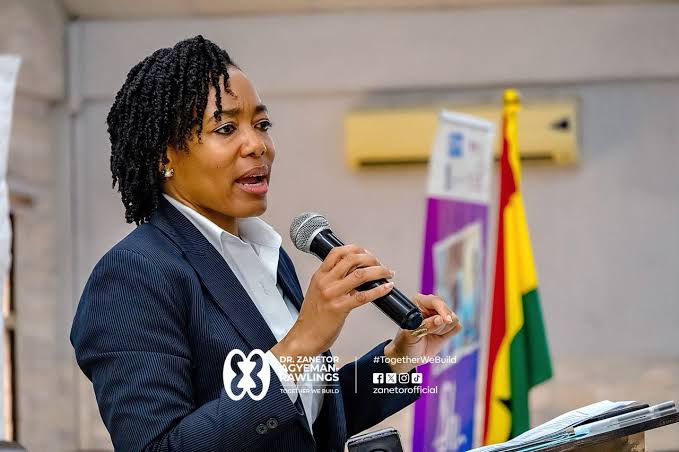
Ghana’s Minister for Environment, Science and Technology, Dr Zanetor Agyeman-Rawlings, has declared 2027 the Year of Pollution Control, outlining four major environmental interventions aimed at addressing pollution, restoring degraded landscapes and protecting public health in Ghana.
Speaking at the launch of the National Water Restoration and Rehabilitation Framework in Ho, the Minister identified river and land restoration, implementation of air-quality regulations, a styrofoam ban and restrictions on certain pesticides as the government’s priority interventions for 2027.
“And finally, ladies and gentlemen, I would like to take the opportunity in declaring 2027 the year of pollution control.”
The announcement forms part of the government’s broader environmental protection agenda under President John Dramani Mahama, with the Minister emphasising that the interventions seek to protect both the environment and human life.
River and Land Restoration Take Centre Stage
Dr Zanetor identified the restoration of degraded rivers and land as the first major intervention under the government’s pollution-control agenda. The priority comes against the background of extensive environmental degradation caused by illegal mining, excessive siltation, indiscriminate waste disposal and other forms of pollution.
At the launch of the National Water Restoration and Rehabilitation Framework, she explained that Ghana must adopt a coordinated approach to restoring water resources that have historically supported agriculture, fisheries, domestic consumption and industrial activities.
The Minister noted that environmental degradation has become a serious concern because communities increasingly depend on natural resources that are being compromised by pollution.
She therefore stressed that restoration efforts must begin by preventing further environmental destruction rather than allowing harmful activities to continue while government spends public resources on rehabilitation.
Dr Zanetor directed the EPA to collaborate with the Water Resources Commission, relevant ministries, security agencies, MMDAs and traditional authorities to identify and protect water bodies and their designated riparian buffer zones.
She also called for reliable baseline water-quality data, pollution-source assessments and measurable restoration targets to guide the programme. The Minister maintained that restoration projects must be informed by scientific evidence and evaluated through measurable improvements in environmental conditions.
Air-Quality Regulations to Address Backyard Burning
The second intervention focuses on implementing air-quality regulations, particularly measures to address the practice of burning rubbish in residential backyards. Dr Zanetor issued a direct warning to individuals who continue to burn household waste, indicating that the practice would no longer be permitted from January 2027.
“So those of you who still burn rubbish in your backyards, please take note. Come January, this will not be allowed. So please stop doing it now.”
The announcement places household waste management and compliance with air-quality regulations among the government’s environmental priorities for the coming year. The Minister’s warning also highlights the importance of public participation in environmental protection, particularly as the government seeks to address pollution at its source.
Her remarks formed part of a broader argument that environmental regulations must translate into practical changes in individual behaviour and institutional enforcement.
The Minister also called on local assemblies to take their responsibilities seriously, emphasising their role as extensions of central government with obligations to protect communities and enforce relevant policies.
Styrofoam Ban Expected To Take Effect In January
The third intervention involves the planned ban on styrofoam, which Dr Zanetor disclosed would also come into force in January 2027. She explained that the measure is intended to address environmental concerns as well as the potential health implications associated with the use of styrofoam.
“The styrofoam ban is coming into force also in January. And also to point out that there are health implications around the use of styrofoam. So this is government making sure that it’s not just the environment but human life that is being protected and preserved.”
Her remarks place the planned ban within a broader public health and environmental protection agenda. The announcement also reinforces the government’s intention to address sources of pollution through regulatory measures rather than relying solely on environmental clean-up and restoration activities.
Dr Zanetor’s position suggests that preventing harmful materials from contributing to environmental degradation forms an important part of the national pollution-control strategy.
Government Targets Certain Pesticides
The fourth intervention involves a ban on certain pesticides, although the Minister did not identify the specific products or provide further details about the implementation arrangements in her address.
She presented the measure as another component of the EPA and ministry’s environmental protection priorities for 2027. The announcement broadens the pollution-control agenda beyond river contamination, household waste and styrofoam to include the regulation of certain agricultural and chemical products.
However, the speech did not specify the pesticides affected, the precise enforcement timeline or the regulatory procedures governing the proposed restrictions. Dr Zanetor indicated that the four interventions reflect measures the ministry and EPA have achieved or are working to implement under the current administration.
She also emphasised the government’s intention to demonstrate environmental leadership through practical action.
Government Seeks To Lead By Example
The Minister connected the 2027 environmental agenda to Ghana’s anticipated leadership role within the African Union. She noted that President John Dramani Mahama would assume the AU chairmanship in 2027, adding that Ghana intended to demonstrate its commitment to environmental protection through example.
“We intend to set the example by leadership. Next year, his excellency will be assuming the AU chairmanship and by example we will show the rest of Africa that we intend to lead by example.”
The Minister’s announcement also comes alongside the launch of the National Water Restoration and Rehabilitation Framework, which establishes a coordinated approach to addressing water pollution and rehabilitating degraded water bodies.
Under the framework, the EPA will lead environmental regulatory coordination, technical supervision and verification of restoration outcomes, working with scientific institutions and other relevant stakeholders.
Dr Zanetor has also called on communities, traditional authorities, local assemblies and private sector partners to support environmental protection efforts. She stressed that government cannot achieve sustainable environmental restoration without the active participation of citizens and institutions.
The declaration of 2027 as the Year of Pollution Control therefore introduces a wider environmental agenda that combines river and land restoration with regulatory enforcement, restrictions on selected products, and greater public responsibility.
The effectiveness of the initiative will depend on how the announced interventions are translated into enforceable measures and measurable improvements in environmental and public health conditions.

